
Opinion: What is the responsibility of artists during political polarization?
- Hamdan Tariq

- Jun 6
- 5 min read
Every polarized era asks artists to pick a side. Manto picked the human being.

Saadat Hasan Manto (1912–1955) wrote over 250 short stories in a career spanning two decades. His stories focused almost entirely on people society preferred to ignore:
the psychologically shattered
sex workers
criminals
refugees
When Partition split the subcontinent in 1947, killing up to 2 million people and displacing 10–20 million more, the official narrative needed heroes and martyrs. Manto gave them Toba Tek Singh: a story set in a mental asylum, where the only sane response to the violent Partition is madness.
ہندوستان آزاد ہو گیا، پاکستان آزاد ہو گیا ۔
hindūstān āzād hō gīā, pākistān āzād hō gīā
لیکن انسان دونوں ملکوں میں غلام رہا۔
lēkin insān dōnōñ mulkōñ mēñ GHulām rahā
"Hindustan became free. Pakistan became independent.
But man remained a slave in both countries."
Manto's short stories were banned six times: three before Partition in colonial India: Dhuan, Bu, and Kali Shalwar. Three were banned afterwards in Pakistan: Khol Do, Thanda Gosht, and Ooper Neeche Darmiyan. What did these stories contain? The truth about what men did to women during Partition.

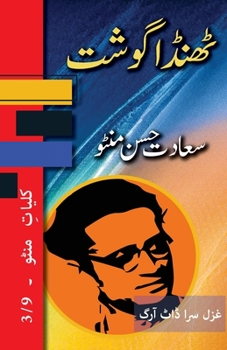
Khol Do (Open It): A father searches for his daughter Sakina amid the chaos of Partition. When she is found, unconscious and barely alive, a doctor's command "open it" causes her to instinctively loosen her clothing. She had been repeatedly raped.
Thanda Gosht (Cold Flesh): A man confesses to his lover that during the riots, he tried to assault a woman, only to find she was already dead. The story explores the psychological aftermath of communal violence through this harrowing encounter.
The state called these stories obscene. Manto called them journalism. Through the specificity of his stories, Manto was able to illustrate the humanity hidden behind heated controversy. His books were nonetheless banned across governments, dragging the author to court each time.
Though often acquitted, the trials completely drained Manto's energy and finances, while reinforcing his self-image as an embattled truth-teller forced to speak precisely because others wished to silence him. For Manto, the court was "a place where every humiliation is inflicted and where it must be suffered in silence."
After one trial, the judge met Manto at a coffee house and expressed his admiration for the writer. When Manto asked why he had been fined, the judge said he would tell him in a year. Manto passed away before that year was up. The judge's reply was published: "The intention of law is not to obstruct literature from fulfilling its objectives." The very system that punished him knew he was right and punished him anyway.

Both India and Pakistan used colonial-era British obscenity laws to suppress his work. There are no copies of his stories available in the Urdu collections of university libraries, banned on grounds of having a "corrupting influence on youth." In 1948, Manto published Siyah Hashiye, 32 micro-stories about Partition, some only a paragraph, some only two lines. In his introduction, Manto wrote: "I tried to retrieve from this man-made sea of blood, pearls of rare hue, by writing about the single-minded dedication with which men had killed men, about the remorse felt by some of them, about the tears shed by murderers who could not understand why they still had some human feelings left."One story, Jelly, is a single setting: a child mistakes an ice vendor's blood, mixed with melted ice from his cart, for jelly.
In 1950, silencing an artist required a courtroom, a judge, a filing under Section 292. The process to ban media took months; today it only takes hours. In 2024, six authors were dropped from a State Library Victoria teen writing program in Australia. The stated reason was "child and cultural safety." Public speculation followed that the actual reason was four of the authors' public support of Palestine, and that the cancellation was an attempt at censorship. The library initially sent a "termination agreement" to the writers involved.
The charge may change. Obscenity, child safety, cultural sensitivity. The logic behind them is tried and tested: make the truth-teller the spectacle so no one has to deal
with the truth. In 2025, painter Amy Sherald canceled her planned exhibition at the National Portrait Gallery in Washington. Sherald canceled over fears that her portrait of a Black trans woman dressed as the Statue of Liberty would be censored amid the Trump administration's crackdown on the Smithsonian Institution.


The pressure on artists during political crisis is always the same: choose a side. Manto chose specificity over abstraction. The individual over the ideology. Sakina, the woman in Khol Do, over "the victims of Partition." Bishan Singh, dying on the border between India and Pakistan in Toba Tek Singh, over "the tragedy of displacement."
Manto's era had outrage too, but it had friction. A letter to the editor, petitions to a local court, time to digest his writing. Social media has removed that friction entirely.
Research published in Science in 2025 found that algorithmic content on social media platforms shapes political hostility at scale, and that 74% of users reported noticing no impact on their experience. These effects operate below conscious awareness. The result: artists and writers now navigate not just state censorship but crowd censorship, mob dynamics amplified by platforms that profit from conflict.
"میں اس سماج کے کپڑے اتارنے کی کوشش نہیں کرتا جو خود ننگا ہے۔ یہ درزیوں کا کام ہے، میرا نہیں"
Manto wrote: "If you cannot bear these stories then the society is unbearable. Who am I to remove the clothes of this society, which itself is naked. I don't even try to cover it, because it is not my job--that's the job of dressmakers."
The responsibility of an artist during polarization is not to be louder than the noise, but to be more precise than it. Every polarized era asks artists to pick a side. Manto's answer was consistent through his work: I pick the human being.
Manto struggled with alcoholism, which contributed to his death at 42. He died in Lahore on January 18, 1955, penniless, estranged from Bombay, still fighting for his right to write what he had seen. He wanted his epitaph to read: "Here lies Saadat Hasan Manto, and with him lie buried all the secrets and mysteries of the art of short-story writing — still wondering who among the two is greater short-story writer: God or He."
The answer history gave: his work outlived every government that tried to suppress it.
Published For © Kosh-E-Lughat 2026


Comments