
Iqbal’s Most Daring Line?
- Hamdan Tariq

- Apr 26
- 3 min read
Why does Iqbal give the sharpest line in Bāl-E-Jibrīl to Iblees?
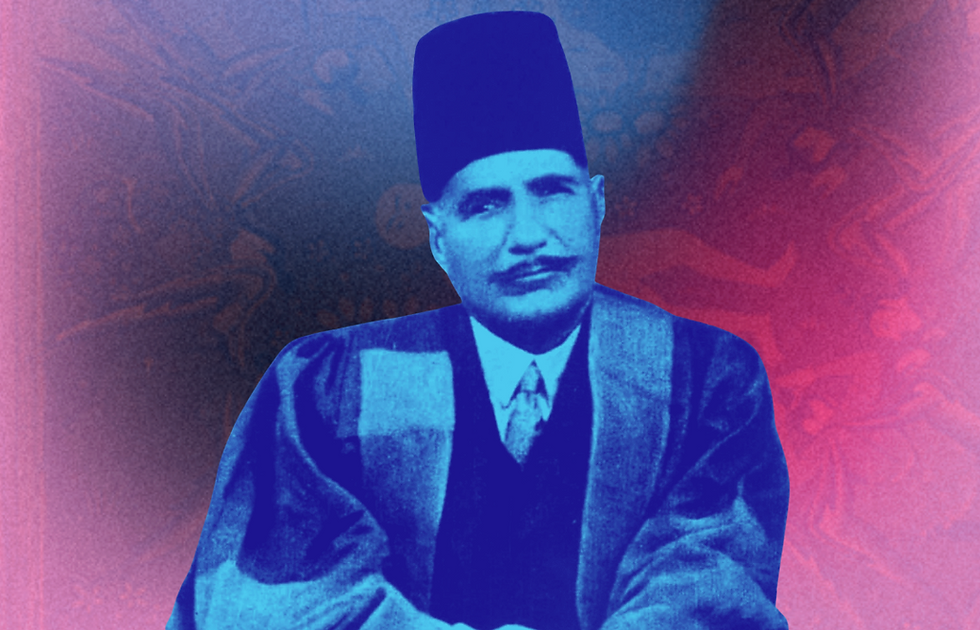
Jibreel-o Iblees, from Bal-e Jibreel, is built as a dialogue between two opposites:
Jibreel (archangel Gabriel) stands for obedience, revelation, and celestial order.
Iblees (Satan) stands for refusal, disruption, temptation, and conflict.
But Iqbal does something startling. He does not let the angel explain the human condition. He provocatively lets Iblees do it, asking who understands what gives history its movement. Iqbal’s Iblees is not “right.” He is dangerous because he understands movement. For him, the world is not a place of peace. Instead, as he writes:
"سوز و ساز و درد و داغ و جستجو و آرزو"
sōz-o-sāz-o-dard-o-
dāgh-o-justujū-o-ārzū
“Burning, making, pain, wounds, searching, desire.”
That line acts the poem’s thesis. Iblees describes life as conflict, but also as the only place where human beings become more than passive creatures. Jibreel then asks if Iblees’s torn robe can still be repaired.
It sounds merciful, but Iblees refuses the offer because heaven now feels static to him. His rebellion has exiled him from order, but it has also tied him to history. Iqbal is staging a brutal contrast: purity without struggle versus corruption with movement.
The poem’s central accusation comes when Iblees tells Jibreel that he only watches the battle of good and evil from the shore. Iblees claims that he is inside the storm. He suffers the blows, creates temptation, provokes choice, and forces Adam’s descendants into action.
In Iqbal’s world, moral greatness cannot exist without resistance. Then comes the sharpest line:
میں کھٹکتا ہوں دلِ یزداں میں کانٹے کی طرح
mēñ kHaTkatā hūñ dil-e-yazdāñ mēñ kānTē kī tarah
تو فقط اللہ ہو، اللہ ہو، اللہ ہو
tū faqat allah hū, allah hū, allah hū
"I prick the heart of God like a thorn.
You only repeat: Allah Hu, Allah Hu, Allah Hu."
The attack is not only on Jibreel. It is aimed at a kind of religion that becomes repetition without transformation. Iqbal admired spiritual depth, but he repeatedly attacked passivity, fatalism, and a piety that withdraws from history. That is why Iblees gets the most violent line: he exposes the difference between devotion and action.
The poem ends without Jibreel answering, and this silence matters. Iqbal leaves the scandal unresolved because the answer cannot come from angels or devils. It has to come from the human being. The real question is not whether Iblees wins the argument.It is whether humans will remain spectators, or enter history with responsibility.
Iqbal admired spiritual depth as a crucial element of personal and collective growth, recognizing that true spirituality involves an active engagement with the world rather than a mere contemplative existence. He believed that spirituality should inspire individuals to take meaningful action and contribute positively to society. This is evident in his repeated critiques of passivity, which he viewed as a detrimental state that hinders progress and stifles the potential for change.
Fatalism, in his perspective, was equally problematic; it represented a resigned acceptance of circumstances without striving for improvement or transformation. Iqbal argued that such a mindset leads to stagnation and undermines the dynamic nature of human experience. Furthermore, he was particularly critical of a form of piety that withdraws from the complexities of history and societal issues, advocating instead for a spirituality that actively engages with the challenges of the time.
This philosophical stance is poignantly illustrated in his treatment of Iblees, the figure often associated with rebellion and dissent. Iblees, in Iqbal's narrative, embodies the tension between mere devotion and the necessity of action. The most violent line attributed to Iblees serves to highlight this critical distinction: it emphasizes that true devotion must be accompanied by a willingness to confront injustices and to challenge the status quo. Iqbal's portrayal of Iblees is not simply one of evil; rather, it serves as a powerful metaphor for the struggle between passive acceptance and active engagement.
Through this lens, Iqbal invites individuals to reflect on their own spiritual journeys and to consider how their beliefs can translate into concrete actions that shape history and contribute to the betterment of humanity. Ultimately, his work calls for a robust spirituality that is not only introspective but also outward-looking, urging individuals to become agents of change in a world that often seems resistant to transformation.
References:
Muhammad Iqbal, “Jibrīl-o-Iblīs,” in Bāl-e-Jibrīl (Lahore, 1935).
Frances W. Pritchett, “Jibril o Iblis,” A Desertful of Roses: The Urdu Ghazals of Mirza Ghalib and Other Urdu Texts, Columbia University.
Ali Altaf Mian, “A Translation, Transliteration, and Commentary on Muhammad Iqbal’s ‘Jibreel-o Iblees,’” Maydan, July 30, 2019.
“Iblis in Iqbal’s Philosophy,” Iqbal Review, Iqbal Academy Pakistan, October 1984.
Annemarie Schimmel, Gabriel’s Wing: A Study into the Religious Ideas of Sir Muhammad Iqbal (Leiden: Brill, 1963).
Published For © Kosh-E-Lughat 2026


Comments