
Opinion: Where Have All the Poets Gone?

Why today’s wave of authoritarianism has failed to produce a corresponding surge in protest poetry.

مرا قلم تو امانت ہے میرے لوگوں کی
mirā qalam tō amānat hē mērē lōgōñ kī
مرا قلم تو عدالت مرے ضمیر کی ہے
mirā qalam tō adālat mirē zamīr kī hē
اسی لیے تو جو لکھا تپاک جاں سے لکھا
isī līyē tō jō likHā tapāk-e-jāñ sē likHā
جبھی تو لوچ کماں کا زبان تیر کی ہے
jabHī tō lōch kamāñ kā zabān tīr kī hē
میں کٹ گروں کہ سلامت رہوں یقیں ہے مجھے
mēñ kaT girūñ ki salāmat rahūn yaqīñ hē mujHē
کہ یہ حصار ستم کوئی تو گرائے گا
ki ye hisār-e-sitam kō'ī tō girā'ē gā
تمام عمر کی ایذا نصیبیوں کی قسم
tamām umr kī īzā-nasībīyōñ kī qasam
مرے قلم کا سفر رائیگاں نہ جائے گا
mirē qalam kā safar rā'ēgāñ na jā'ē gā
سرشت عشق نے افتادگی نہیں پائی
sarisht-e-ishq nē uftādagi nahīñ pā'ī
تو قد سرو نہ بینی و سایہ پیمائی
tū qadd-e-sarv na bīnī ō sāya-pēmā'ī
My pen is the pious gift of my people.
My pen is the court of my conscience.
That is why what I have written is written with a fevered soul.
That is why it has the tension of the bow and the tongue of an arrow.
Whether I am felled or remain alive I trust
That someone will break this siege of oppression.
In the name of those tortured down the ages
The journey of my pen will not be in vain.
The character of my love cannot be destroyed.
From the top of the tree you cannot see nor measure its shadow.
From Muhasara (The Siege) by Ahmad Faraz, translated by Mohsin Zulfiqar
Ahmad Faraz was arrested after reading this poem at a 1978 mushaira in Sindh. It was the Pakistani poet’s scathing satire of General Muhammad Zia-ul-Haq’s military regime that led to his detention. After orchestrating a military coup (Operation Fair Play) in 1977, which successfully led to the overthrow and incarceration of elected Prime Minister Zulfikar Ali Bhutto, Zia-ul-Haq imposed martial law and broke his promise to hold free and fair elections within 90 days. He went on to become the longest ruling de facto head of state.
Love is the center and circumference of Faraz’s work. This is evident in “Muhasara” (The
Siege); the character of Faraz’s love “cannot be destroyed.” It is an undying passion, for his people, for justice, for truth, so deep it becomes constitutive of the self. This love is the ink that flows through his pen. Faraz remains unconcerned at the threat of arrest, forcible silence, or even death, because he knows that one cannot kill the kind of love for his country that compelled him to write and speak out.
Faraz went into a six-year self-imposed exile in Canada and Europe during Zia-ul-Haq’s reign after observing the erosion of the state he had so fervently written in support of. “That was the worst phase for our country’s writers,” he once said of the general’s rule. “Yet it also provided ample food for thought for the poet and made protest poetry so popular in Pakistan.”
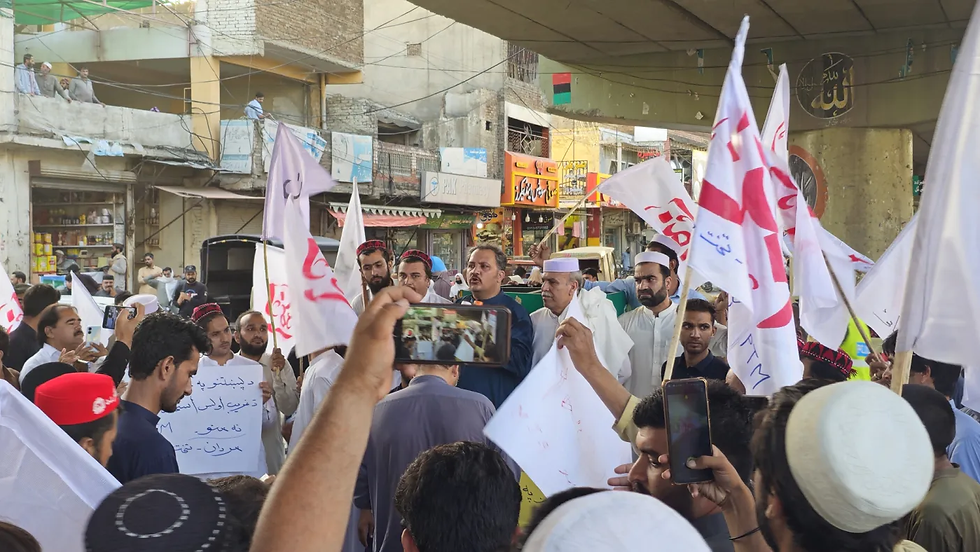
Today, Pakistan appears to be mired in a similar decline. Under the current government of Shehbaz Sharif, former Prime Minister Imran Khan remains imprisoned, censorship laws have expanded, and military hegemony goes unchecked. Amid increasing democratic backsliding and weakening of state capacity, Pakistan’s slide toward authoritarianism and autocracy is evident. There is once again “ample food for thought for the poet” in Pakistan. However, this time, protest poetry is not as popular. The anti establishment tradition is deeply embedded in the region’s literary history and is powerfully reflected in the poetry of Ahmad Faraz, so why has it disappeared?
Where have all the poets gone?
In 2025, Balochi poet Mir Allah Bakhsh Shahzad was murdered. In 2024, Pashtun resistance poet Gilaman Wazir died following a suspected attack in Islamabad. Pakistan remains a dangerous environment for journalists, with several murders reported in 2024 and 2025, particularly in Sindh and Balochistan provinces. Recent cases include the 2025 killings of Abdul Latif Baloch and Imtiaz Mir, following a surge of violence in 2024 involving journalists like Nasrullah Gadani and Kamran Dawar, who were often targeted for reporting on human rights and politics. Pakistan’s high levels of violence and threats from both state and non-state actors have fostered a tense environment of self-censorship.
According to the V-Dem Liberal Democracy Index 2026 Report, Pakistan is categorized as an autocracy and has dropped to 117th out of 179 countries on its degree of democracy. Freedom House’s Freedom in the World 2026 Report gave Pakistan a score of 32 out of 100, ranking them as “partly free.” These assessments reflect a challenging environment for civil rights, electoral autonomy, press freedom, and internet access. Recent declines have been greatly intensified by worsening political instability and military influence.
Although freedom of speech and expression is guaranteed in Pakistan’s constitution, it is heavily restricted in practice through censorship, mass surveillance, military hegemony, and legal frameworks, such as the Prevention of Electronic Crimes Act (PECA), which was significantly updated by the 2025 amendment. Critics argue that the law is frequently used to restrict freedom of expression and target journalists or dissenters. It applies to all Pakistani citizens, regardless of their location, and to any person present in Pakistan. The 2025 Amendments introduce strict penalties (up to three years imprisonment and a 2 million PKR fine) for spreading false information that causes fear or panic. It also establishes the Social Media Protection and Regulatory Authority (SMPRA) to monitor, regulate, and remove content deemed unlawful on social media platforms. PECA mandates service providers to maintain traffic data for at least one year, and allows Pakistan Telecommunication Authority (PTA) to block online content deemed against the “glory of Islam,” “security of Pakistan,” or “public order”. The 2025 amendments even allow for arrests without a warrant for specific offenses. This framework faces significant scrutiny from media rights groups for being draconian and restricting freedom of expression and the press.

With critics arguing that PECA is being utilized to target political dissent, the systematic
silencing of poets and journalists is now being done on a stricter and broader scale. Unlike Faraz’s time, the prominent killing of poets and the imposing reach of PECA have instilled deep-seated fear in being outspoken, squashing any desire for resistance. Pakistan is experiencing a renewed authoritarian pressure, yet this moment has not produced a corresponding surge in protest poetry. Today, due to the repression of poetry and the prevalence of self-censorship, Pakistani poets are unable to call out the government’s contradictions and hypocrisies on the international stage.
Amidst the ongoing Iran war, Pakistan has hosted US-Iran ceasefire negotiations in Islamabad. Pakistan’s emerging image as a harbinger of peace is calculated. To project this image of a “responsible” broker abroad, the establishment continues to suppress domestic dissent, including the cultural subversion of poetry and independent journalism to eliminate anything and everything that does not align with the official state narrative.
In a political climate where entropy reigns supreme, Pakistan fears slipping into oblivion in a shifting world order. Pakistan’s role as a mediator and negotiator in the war with Iran not only demonstrates appeasement to the United States, whose role as the global hegemon is threatened, but also reflects hope that potential action translates into kinetic political control. The nation is now seen as a valuable partner to the United States and has the chance to assert itself as an indispensable ally and architect in building security in the Middle East.
Prime Minister Shehbaz Sharif claims, “Pakistan remains fully committed to its role as an honest and sincere facilitator of lasting peace and regional stability.” While Pakistan is trying to de-escalate tensions on one end, it is worth noting the escalation of tensions with Afghanistan, following the bombing in Kabul weeks earlier. Pakistan is simultaneously claiming legitimacy as a peacemaker abroad, with the recent Islamabad Memorandum of Understanding, while exercising force at home and across its borders.
To make sense of these contradictions, reading Faraz remains especially important today in striking through the mask and facades. Art and literature serve as barometers of society; they reflect political pressure, public sentiment, and the limits placed on freedom of expression. Many of the struggles Faraz confronted remain modern realities, making his poetry a necessary and relevant lens for understanding how creative dissidence endures amid political repression.

Poets, journalists, and artists continue to face the kind of violence they endured during Faraz’s lifetime, be it intimidation, abduction, or death. In a country where poetry is so integral to the nation’s cultural identity, silencing poets is akin to blocking the blood that runs through the country’s veins.
Faraz believed, “The problem is that our work is not being translated into other languages, so the world knows nothing about what is happening in Urdu.” To him, Faiz Ahmed Faiz was as deserving of a Nobel as Octavio Paz, a gap he saw as evidence of how much was being lost to the world. He claimed, “There is a dire need for what I call cultural landscaping. People have stopped reading, which is sad. What is even worse is that comparative studies have become a thing of the past. We need to keep abreast of what is happening in other languages.”
Ahmad Faraz mobilized Urdu as a vehicle to distill complex political realities into beautiful, widely resonant verse under authoritarian governance. In the past, Urdu poetry demonstrated how revolutionary embers are kindled and how resistance circulates even during military rule. Today, from a political standpoint, one’s capacity to interpret is stifled, both within Pakistan and those on the periphery. Given the state of Pakistan today, it begs the question: Will the journey of Faraz’s pen die in vain?
I encourage you, my reader, to keep abreast of what is happening in other languages and the ones you have forgotten.
Published For © Kosh-E-Lughat 2026


very cool read!